
Almost every guide to this model tells you it's “circular” and stops there. Almost none of them tell you who Osgood actually was, or answer the exam-style question that keeps showing up in student searches: in this model, what exact three roles does each participant hold at once? This guide answers both, along with the six-message worked example most summaries skip entirely.
You'll get the model's full origin story, its structure, a genuinely worked example (not just a labelled diagram), real applications across five fields, an honest critique, and a clear distinction from Schramm's own separate 1954 interactive model — which is a different, related framework, not the same thing. If your assignment is due soon, PragmaHelp's communication specialists can help you turn this into a polished submission.
Communication Assignment Help — PragmaHelp
Featured-snippet answer: The Osgood-Schramm model (1954) is a circular communication model in which both participants act simultaneously as encoder, decoder and interpreter, exchanging messages back and forth until shared meaning is reached, rather than one person only sending and the other only receiving.
Quick answer: Developed by psychologist Charles Osgood and communication scholar Wilbur Schramm, this model rejected the idea that communication is a one-way delivery of information. Instead, it treats meaning as something two people build together, in real time, each taking on the same three roles — encoder, decoder, interpreter — in a continuous, equal exchange.
Key Takeaways
|
Diagram: The Circular Structure
Unlike a linear model with a start and an end, this one has none — the loop simply continues.
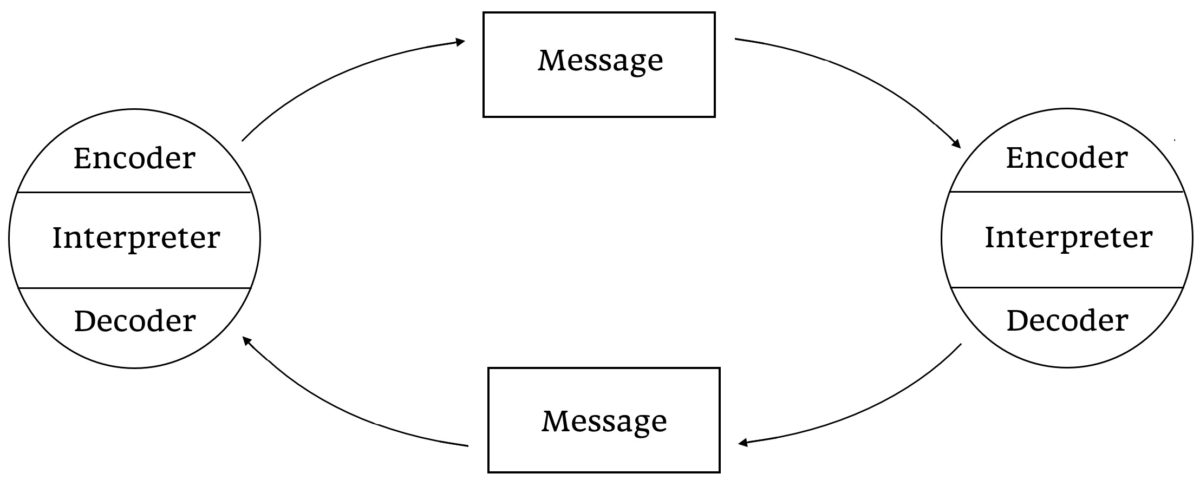
Each arrow is a message; each person holds all three roles at once, on every turn.
Who Were Osgood and Schramm?
Most summaries treat this model as simply “Schramm's other model.” That undersells Charles Osgood's own, quite separate, contribution.
Charles E. Osgood (1916–1991)
An American psychologist at the University of Illinois best known for developing the semantic differential, a research technique for measuring the connotative meaning people attach to words and concepts by rating them on scales between opposite adjectives (such as good/bad or strong/weak). Osgood's core interest was how meaning forms inside an individual mind, not just how signals travel between two points — which is exactly the perspective this model brings to communication.
Wilbur Schramm (1907–1987)
A founding figure in American communication studies, based at the University of Illinois at the same time as Osgood. Schramm had already proposed his own separate interactive model in 1954 (built around source, destination and “field of experience”); the Osgood-Schramm model emerged from the two scholars combining Osgood's psychological view of meaning-making with Schramm's interest in two-way exchange.
A quick pronunciation note, since it's a common search: Osgood is pronounced “OZ-good,” not “OS-good.” The model is also sometimes searched for as the “reception model,” though “Osgood-Schramm model” remains the standard academic name.
The Model’s Structure and Core Principles
Encoder, Decoder, Interpreter — Held Simultaneously
This is the detail most revision pages compress into a single sentence, and it is also the direct answer to a common exam-style question: in the Osgood-Schramm model, both participants act as encoder, decoder, and interpreter at the same time — not in separate turns, but continuously, throughout the exchange.
- Encoding: translating an idea into words, gestures, or another symbol system to send.
- Decoding: receiving and parsing an incoming message.
- Interpreting: assigning personal meaning to the decoded message — the step Osgood's own background in meaning-measurement most directly shaped.
Circularity, Not Linearity
There is no fixed “start” or “end.” Person A's message becomes the input to Person B's interpretation, which shapes Person B's next message back to Person A, and so on — a genuine loop rather than a line.
Equal and Reciprocal Roles
Both participants hold identical capabilities. Neither is permanently a “sender” or “receiver”; the roles are symmetric and swap continuously.
Semantic Noise
Because interpretation depends on each person's own values, beliefs and background knowledge, meaning can be lost or distorted even when a message is technically received intact. The noise here is specifically semantic — rooted in differing meaning, not in a poor connection or background sound — which is what distinguishes it from the physical and mechanical noise Shannon and Weaver described. Repeated exchange gives the pair a chance to narrow that gap over successive turns, rather than eliminating it in one pass.
A Fully Worked Example: Negotiating a Deadline Extension
Most guides give you a labelled diagram. Here is an actual turn-by-turn exchange, so you can see the loop in motion.
- Turn 1 (Employee encodes): “I'm not going to make Friday's deadline — can we push it to Monday?”
- Turn 1 (Manager decodes and interprets): hears a request, but also infers (rightly or wrongly) that the project may be behind more broadly.
- Turn 2 (Manager encodes): “Is it just this deliverable, or is the whole project slipping?”
- Turn 2 (Employee decodes and interprets): hears concern, but also senses mild pressure, and clarifies to manage that impression.
- Turn 3 (Employee encodes): “Just this piece — everything else is on track. I'll confirm by Monday morning.”
- Turn 3 (Manager decodes, interprets, and replies): reassured, agrees to the extension.
Notice that both people encoded, decoded and interpreted on every single turn — there was never a fixed “sender” and “receiver.” Semantic noise shows up in Turn 1's misread ('project slipping' vs. 'one deliverable slipping'), and the loop itself is what resolves it, over three exchanges rather than one.
Applications of the Osgood-Schramm Model
Interpersonal Communication and Conflict Resolution
The model's turn-by-turn structure is the clearest available framework for analysing a real back-and-forth disagreement, exactly as in the worked example above.
Negotiation and Mediation
Professional negotiators rely on the same repeated encode-decode-interpret cycle to narrow a gap in understanding across several rounds rather than expecting one message to resolve everything.
Customer Service and Live Chat
A support agent and customer exchanging messages in real time — each clarifying, each adjusting — is a close real-world match for the model's circular, equal-turn structure.
Counselling and Therapeutic Communication
Therapeutic dialogue depends on continuous mutual interpretation and re-encoding, which is precisely what this model, unlike a one-way model, is built to represent.
Cross-Cultural and Intercultural Exchange
Because interpretation is explicitly shaped by each person's background, the model gives a clean vocabulary for explaining why the same words can be decoded correctly but interpreted very differently across cultures — and why repeated exchange, not a single message, is what closes that gap.
The Osgood-Schramm Model vs Schramm's Own Interactive Model — Not the Same Thing
Because both bear Schramm's name and both date to 1954, these two models are routinely conflated. They are related but structurally different.
| Osgood-Schramm Circular Model | Schramm's Own Interactive Model | |
|---|---|---|
| Core structure | Two participants, each simultaneously encoder, decoder and interpreter, in a continuous loop | Source/Encoder and Destination/Decoder as distinct roles, linked by feedback |
| Signature concept | Simultaneous encode-decode-interpret cycle | Overlap between source’s and destination’s “fields of experience” |
| Best used for | Equal, two-party dialogue (negotiation, counselling, chat) | Any interactive exchange, including where roles and backgrounds differ more sharply |
| Contributing scholar | Charles Osgood (psychologist) + Wilbur Schramm | Wilbur Schramm alone |
For a deeper look at Schramm's own separate model, see our dedicated Schramm's Model of Communication guide — treating the two as identical in an assignment is one of the most common avoidable mistakes.
Strengths of the Model
- Captures real dialogue. Unlike one-way models, it reflects how actual back-and-forth conversation works.
- Treats both parties as active. Neither participant is a passive recipient; both interpret continuously.
- Explains gradual understanding. It shows how shared meaning is built up over several exchanges, not delivered in one message.
- Names interpretation explicitly, where many earlier models leave it implicit or ignore it.
Criticisms and Limitations
- Assumes rough equality. It struggles wherever one party holds more power, authority or airtime than the other — a manager-to-large-team announcement, for instance.
- Not built for mass communication. A newspaper or broadcast reaching thousands cannot realistically hold a circular, turn-by-turn exchange with its audience.
- Semantic noise is named but not measured. The model tells you interpretation can drift; it gives no tool for how far.
- Two-party bias. Group conversations with three or more active participants strain the model's clean back-and-forth structure.
Osgood-Schramm vs Other Models of Communication
| Model | Year | Family | Feedback? | Signature idea |
|---|---|---|---|---|
| Aristotle | Before 300 BC | Linear | No | Persuasion via ethos, pathos, logos |
| Lasswell | 1948 | Linear | No | Who, says what, channel, whom, effect |
| Shannon–Weaver | 1949 | Linear | Contested | Signal transmission and noise |
| Schramm's Interactive Model | 1954 | Interactive | Yes | Field of experience overlap |
| Osgood-Schramm | 1954 | Circular/Transactional | Continuous | Simultaneous encode-decode-interpret |
| Berlo SMCR | 1960 | Linear | No | Source–receiver similarity on five factors |
Osgood-Schramm sits closest to fully transactional models: both parties are always sending and receiving at once, with no clean division of turns.
How to Write a First-Class Osgood-Schramm Assignment
- Name both scholars correctly, and credit Osgood's semantic differential background, not just Schramm's name.
- Explain the simultaneous triple role — encoder, decoder, interpreter held by each participant at once — rather than describing it as simple two-way feedback.
- Distinguish it explicitly from Schramm's own separate interactive model.
- Apply it to a real, multi-turn exchange, not a single message-and-reply pair.
- Critique with evidence, especially its weak fit for mass communication and unequal power.
- Reference properly in your institution's required style.
Common Mistakes to Avoid
- Treating this model and Schramm’s own interactive model as interchangeable.
- Describing it as simply “adding feedback,” which undersells the simultaneous encoder/decoder/interpreter structure.
- Applying it to mass communication, where it does not fit well.
- Omitting Charles Osgood entirely and crediting the whole model to Schramm.
- Copying a definition verbatim from a revision site, which similarity checkers flag immediately.
Osgood-Schramm Assignments Around the World
- USA: APA 7th edition, close adherence to the rubric, frequent case-based application.
- UK: Harvard referencing, heavier weight on critical evaluation than description.
- Canada: APA or MLA, with strict Turnitin similarity screening.
- Australia: APA 7th (AGLC in law-adjacent units), assessed against a published rubric.
- UAE and Kuwait: a mix of UK and US curricula depending on the institution, so confirm which convention applies.
- Europe: ECTS credits under the Bologna Process, with referencing rules set per institution.
How PragmaHelp Supports Your Osgood-Schramm Assignment
PragmaHelp is an academic support platform serving students across North America, the UK, Europe, the Gulf and Asia-Pacific.
Communication Assignment Help — PragmaHelp
- Annotated, turn-by-turn worked examples showing the encoder-decoder-interpreter cycle in action.
- Clear explanations distinguishing this model from Schramm’s own separate interactive model.
- Comparison tables against Aristotle, Lasswell, Shannon-Weaver and Berlo’s SMCR.
- Referencing checks in APA, Harvard or MLA, matched to your institution's style.
- Tutoring sessions to talk through the model until the distinctions are second nature.
Use any material as a study reference and follow your institution's academic integrity policy. Share your brief and deadline through PragmaHelp.com for a quote.
Why Choose PragmaHelp.com for Your Osgood-Schramm Model of Communication Assignment
Who can help with an Osgood-Schramm model of communication assignment? PragmaHelp.com provides human-written, plagiarism-free coaching on the Osgood-Schramm circular model, including the encoder, decoder and interpreter roles and how meaning is created through interaction, for students in the USA, UK, UAE, Kuwait, Saudi Arabia, Singapore, Luxembourg, Canada, Australia and across Europe.
Thousands of students search every day for "Osgood-Schramm model of communication assignment help," "circular model of communication essay help," or "encoder decoder interpreter assignment help," but not every service explains the model's circular logic or who Charles Osgood was. Here is what sets PragmaHelp apart:
- Concept-accurate coaching, not shortcuts. Every assignment is built around the circular structure, the simultaneous encoder, decoder and interpreter roles, and Osgood's semantic-differential background, so you can answer exam-style questions and explain how this model differs from Schramm's own interactive model.
- PhD-level academic coaches and editors. Our coaches and editors bring genuine communication, psycholinguistics and media studies backgrounds to every brief, so your turn-by-turn worked example holds up to a marker's scrutiny.
- 100% AI-free, human-written work. Every draft is written and edited by a person, never generated, and checked for originality before delivery, so the plagiarism-free, AI-free standard your marker expects is met.
- Global academic standards. Whether your institution requires APA 7th, Harvard, MLA or Chicago, each submission is matched to your country's grading expectations, from the USA, UK, UAE, Kuwait, Saudi Arabia, Singapore, Luxembourg, Canada, Australia and across Europe.
- Full-spectrum support. From topic selection and outlines to turn-by-turn worked examples, diagrams, comparison tables against Schramm, Shannon-Weaver and Berlo, critical evaluation and referencing checks, we cover every stage of the assignment.
- 24/7 support across time zones. Deadlines do not follow office hours, and neither does our support team, whether you are studying in London, Dubai, Kuwait City, Riyadh, Singapore, Toronto, Sydney or New York.
- Complete confidentiality. Your brief, your course and your academic journey stay private, always.
If you are stuck explaining why both participants act as encoder, decoder and interpreter at once, or you already have a draft and need the critique sharpened, the PragmaHelp coaching and editing team is ready to guide you, ethically, rigorously and on time. Ready to get started? Share your brief and deadline through PragmaHelp.com today for expert, plagiarism-free Osgood-Schramm model of communication assignment help, wherever in the world you are studying.