
Almost every "models of communication" assignment is really asking one question in disguise: does this scenario involve a one-way message, a two-way exchange with delayed feedback, or a fully simultaneous back-and-forth? Answering that correctly is what separates the three families every communication theory course actually teaches — the linear, interactive, and transactional models — and it's the distinction most study-note sites and pre-written answer sheets get muddled or skip entirely.
Models of communication are conceptual frameworks that explain how a message moves between a sender and a receiver — what stays constant, what can distort it, and whether feedback happens at all. They fall into three families: linear models describe one-way transmission, interactive models add a feedback loop, and transactional models treat both parties as simultaneous senders and receivers. A separate, related family of applied communication models — such as LEAPS and CUDSA — prescribes what to actually do in a conversation rather than describing how messages move; we cover those in dedicated guides linked below.
PragmaHelp's specialists help students research, apply, and write about every model in this family — from a single-model definition assignment through a full comparative essay across all three.
Key Takeaways
- Communication models fall into three families: linear (one-way, e.g. Aristotle's Model, Shannon-Weaver), interactive (two-way with delayed feedback, e.g. Schramm-Osgood's 1954 model), and transactional (simultaneous two-way exchange, e.g. Barnlund's Transactional Model).
- A separate family of applied communication models — LEAPS, CUDSA, Egan's SOLER — prescribes specific steps for a conversation, rather than describing how messages move.
- Communication barriers (physical, psychological, semantic, cultural, physiological, and language) are almost always assessed alongside these models, not as a separate topic.
- Most assignments expect you to identify which model family fits a given scenario and justify why, not just define all three.
- PragmaHelp's specialists cover every model and the barriers topic in depth, for students across the US, UK, UAE, Kuwait, Saudi Arabia, Singapore, Luxembourg, Canada, and Australia.
Linear Models: One-Way Transmission
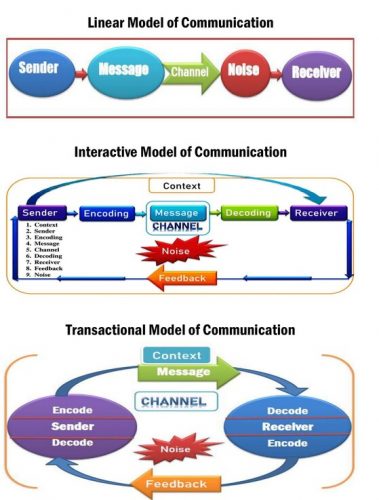
A linear model treats communication as a one-way transmission from sender to receiver, with no built-in feedback loop.
Aristotle's Model of Communication is the earliest version of this idea, built around three elements: the speaker, the speech, and the audience. It's rhetoric-focused rather than technical, and is usually the starting point in a "history of communication models" assignment.
The Shannon-Weaver Model, developed by Claude Shannon and Warren Weaver, formalised the linear idea into five components: sender, encoder, channel, decoder, and receiver, with "noise" as anything that distorts the message along the way. Its main limitation, and the one almost every assignment brief asks you to name, is that it doesn't account for feedback or the social and emotional context around a message. See our complete guide to the Shannon-Weaver model for the full component breakdown, the disputed feedback attribution, and a worked example.
Berlo's SMCR Model builds on the same linear logic but adds depth: Source, Message, Channel, Receiver, plus the specific factors within each — communication skill, attitude, knowledge, social system, and culture — that affect how a message actually lands. It's still fundamentally one-way, but it explains why the same message can be received differently by different audiences.
Interactive Models: Two-Way with Delayed Feedback
An interactive model adds feedback to the linear idea, but treats sending and receiving as separate, alternating steps rather than simultaneous.
Schramm and Osgood's Interactive Model (1954) is the standard reference point here. It depicts both sender and receiver encoding and decoding messages in turn, with feedback closing the loop — but feedback still arrives after the original message, not alongside it. This is the key distinction an assignment expects you to draw against the transactional model below: interactive models have feedback; transactional models have simultaneous feedback.
Transactional Models: Simultaneous Two-Way Exchange
A transactional model treats communication as continuous and simultaneous — both people are sending and receiving at the same time, constantly adjusting based on each other's verbal and non-verbal cues.
Barnlund's Transactional Model, developed by Dean Barnlund, is the standard example. It emphasises that communication isn't a sequence of discrete turns but an ongoing, mutual process shaped by shared context, environment, and both parties' cultural and psychological framing simultaneously. A face-to-face conversation, where you're reading someone's expression while they're still speaking and adjusting your own response in real time, is the clearest example of this model in action — and the one most assignments expect you to use.
Comparing the Three Families
| Model Family | Feedback | Direction | Example Model | Best Suited For |
|---|---|---|---|---|
| Linear | None | One-way | Aristotle's Model, Shannon-Weaver, Berlo's SMCR | Explaining basic message transmission and noise/distortion |
| Interactive | Delayed | Two-way, alternating | Schramm-Osgood (1954) | Explaining turn-based exchanges like email or letters |
| Transactional | Simultaneous | Two-way, continuous | Barnlund's Transactional Model | Explaining live, face-to-face or real-time conversation |
In short: linear models describe a message going one way, interactive models add feedback after the fact, and transactional models treat both people as sending and receiving at once.
As a simple diagram:
Communication Barriers: The Companion Topic
Assignments on communication models are frequently paired with a section on communication barriers — the obstacles that prevent a message from being understood as intended, regardless of which model applies:
- Physical barriers — noise, distance, or interruptions that interfere with transmission (a bad phone connection during a client call)
- Psychological barriers — stress, anxiety, or prejudice that affect how a message is received (a stressed recipient misreading a neutral email as hostile)
- Semantic barriers — jargon, ambiguous language, or terminology differences that cause confusion (a technical term meaning something different to two departments)
- Cultural barriers — differing norms and communication styles that lead to misinterpretation (directness read as rudeness in one culture, honesty in another)
- Physiological barriers — hearing loss, speech impairments, or similar limitations affecting how a message is sent or received
- Language barriers — miscommunication caused by different languages, dialects, or fluency levels between sender and receiver
A model on its own describes how communication should flow; naming the barriers that actually disrupt it in your specific scenario is usually the analytical step that separates a strong answer from a purely descriptive one.
The Applied Models: LEAPS, CUDSA, and SOLER
A separate, often-confused family of models doesn't describe how messages move at all — it prescribes specific steps for handling a real conversation. These show up in management, health and social care, and education modules rather than communication-theory modules:
- The LEAPS Model (Listen, Empathise, Ask, Paraphrase, Summarise) — built for de-escalating emotionally charged conversations. See our complete guide to the LEAPS model.
- The CUDSA Model (Confront, Understand, Develop, Share, Agree) — built for structured negotiation and conflict resolution. See our complete guide to the CUDSA model.
- Egan's SOLER — a non-verbal attending posture (Sit squarely, Open posture, Lean in, Eye contact, Relax) taught alongside both of the above.
If your brief asks you to explain how communication works, you want a model from this guide. If it asks you to resolve a conflict or difficult conversation, you want LEAPS or CUDSA instead.
Common Mistakes in Models-of-Communication Assignments
- Listing every model without grouping them. Naming Aristotle's, Shannon-Weaver, Berlo's SMCR, Schramm-Osgood, and Barnlund's model as five unrelated items, rather than three grouped families, misses the analytical structure most rubrics are actually testing for.
- Treating "2, 3, or 4 types" as a settled number. As the FAQ below explains, this genuinely varies by curriculum — stating one number as universally correct, without checking your own module handbook, is a common and avoidable error.
- Confusing descriptive models with applied models. Shannon-Weaver and Barnlund's model explain how communication works; LEAPS and CUDSA prescribe what to do in a conversation. Mixing them into one undifferentiated list undercuts a comparative essay's structure.
- Skipping the barriers section. A model without an accompanying barriers analysis often reads as descriptively complete but analytically thin, since most rubrics grade the barriers discussion as a separate criterion.
Choosing the Right Model for Your Assignment
Start with what the scenario actually involves. A one-off announcement or broadcast fits a linear model. A written exchange with a gap between messages — letters, emails, forum posts — fits an interactive model. A live conversation, meeting, or negotiation fits a transactional model. If the brief instead hands you a conflict or difficult conversation to resolve, it's asking for LEAPS or CUDSA, not a descriptive model at all.
A strong comparative assignment doesn't stop at defining all three families — it justifies why the scenario given fits one family over the other two, which is exactly the analytical step most pre-written answer sheets and generic study-note pages skip.
One scenario, three lenses: A manager needs to tell a team about a policy change. As a linear model, this is a memo posted on a noticeboard — one-way, no feedback expected. As an interactive model, it's an email the manager sends, to which team members reply with questions days later — feedback exists, but delayed. As a transactional model, it's a live team meeting where the manager explains the change while reading confused expressions in real time and adjusting the explanation mid-sentence — feedback is simultaneous and shapes the message as it's being delivered. Same information, three genuinely different communication processes depending on the channel chosen.
How PragmaHelp Can Help
PragmaHelp's research and writing specialists cover every model in this guide in depth — from a single-model definition assignment to a full comparative essay across linear, interactive, and transactional models, paired with a communication barriers analysis where required. Our support typically includes:
- In-depth guides on individual models, including our dedicated pages on the LEAPS model and the CUDSA model
- Comparative essays across linear, interactive, and transactional models, with the right feedback/direction distinctions drawn out clearly
- Communication barriers analysis, paired with whichever model your brief specifies
- Full originality on every piece of work, written from scratch and checked for plagiarism before delivery
Browse PragmaHelp's full service list or get in touch about a specific communication-models assignment.